
Check out our video review:
Have you played Robotron: 2084? If not, you should, especially if you’re a fan of twin-stick shooters. Released in 1982 as an arcade game, Robotron requires the player to rescue humans and defeat endless waves of robots. It’s a great example of a timeless classic primarily because it’s addictive and easy to pick up and play. You move your character around with one stick and shoot with the other. You might say it popularized the twin-stick genre and I certainly think it’s a landmark title. A must play for anyone who enjoys and appreciates video games. I love a good twin-stick shooter but when I run searches for games like Robotron and Smash TV, I’m usually disappointed because I’ve played most, if not all of the recommended ones so when I discovered Satryn Deluxe on Steam, I was immediately intrigued.
Developed and published by maybell, Satryn Deluxe was released for PC in 2021 and a version called Satryn DX was released for Switch in 2024. For this review, I played the PC version. My research on the game led me to discover the itch.io page for the standard version of Satryn which you can download and play for free. As far as I know, the big difference between the standard and Deluxe version is the latter includes global leaderboards. It’s also selling for seven bucks on Steam as of this review.
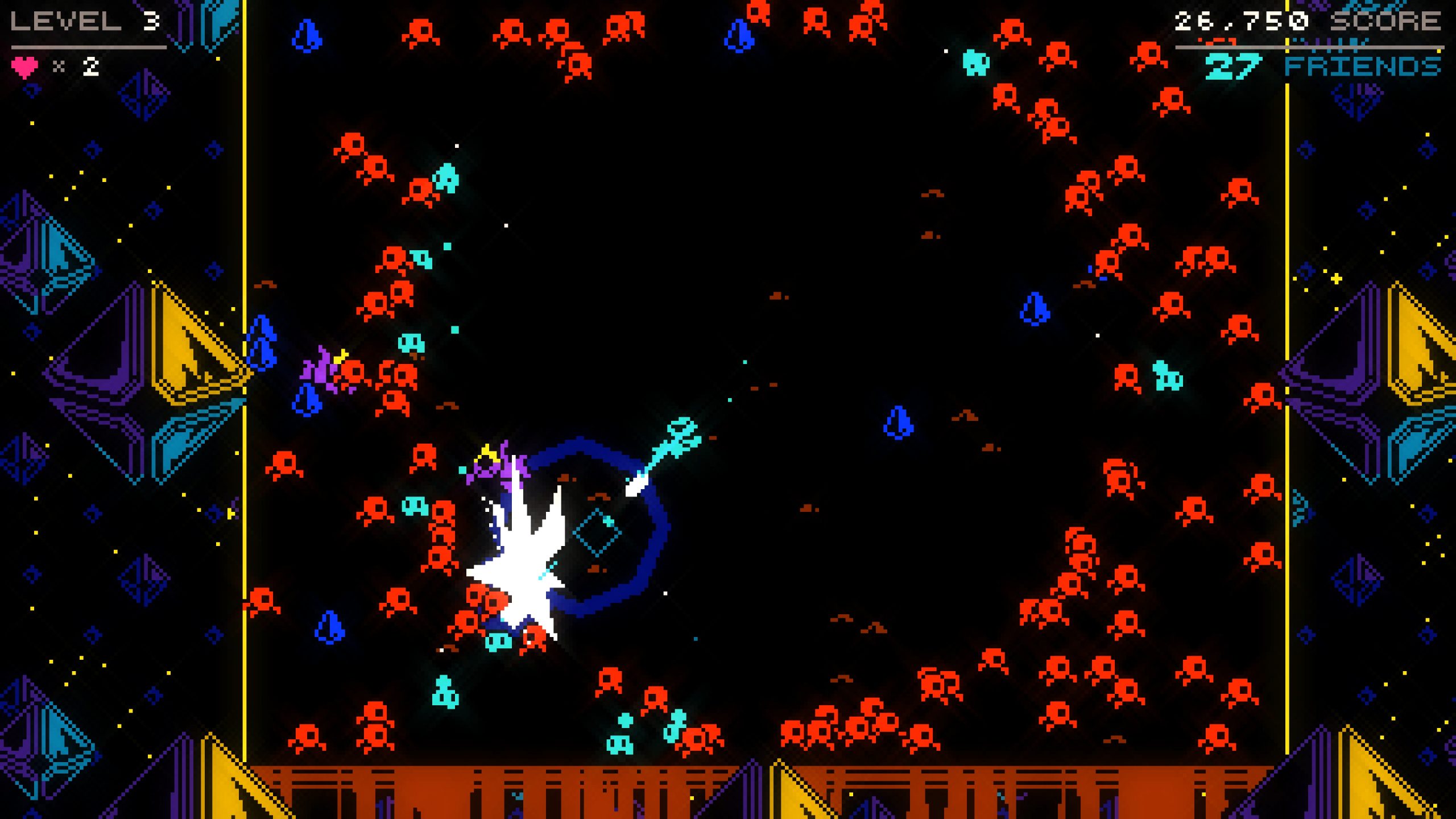
Satryn does come with an in-game manual and I do recommend taking a look at it at least once. It explains the game’s mechanics as well as the premise and more information is revealed inside the manual as you discover things during runs. That said, it shouldn’t take you long to see everything the game has to offer. The story goes your friends have been taken to Satryn and if you don’t save them, they will all be killed. Your friends are sprites of cosmic power that love you very much. And there you have it. You either save your friends or they die.
If you’ve played Robotron: 2084, much of Satryn should be very familiar. Played from a top-down perspective, you go from level to level trying to save your friends, blowing away the enemies that appear, trying not to die, and racking up points in the process. I’m guessing the game goes on endlessly but if there is a final level, I certainly didn’t reach it. Satryn is very much an arcade-style high score chasing experience. Once all your lives are gone, it’s game over and you must start over from the beginning. There are no difficulty levels, no additional game modes, and no multiplayer.
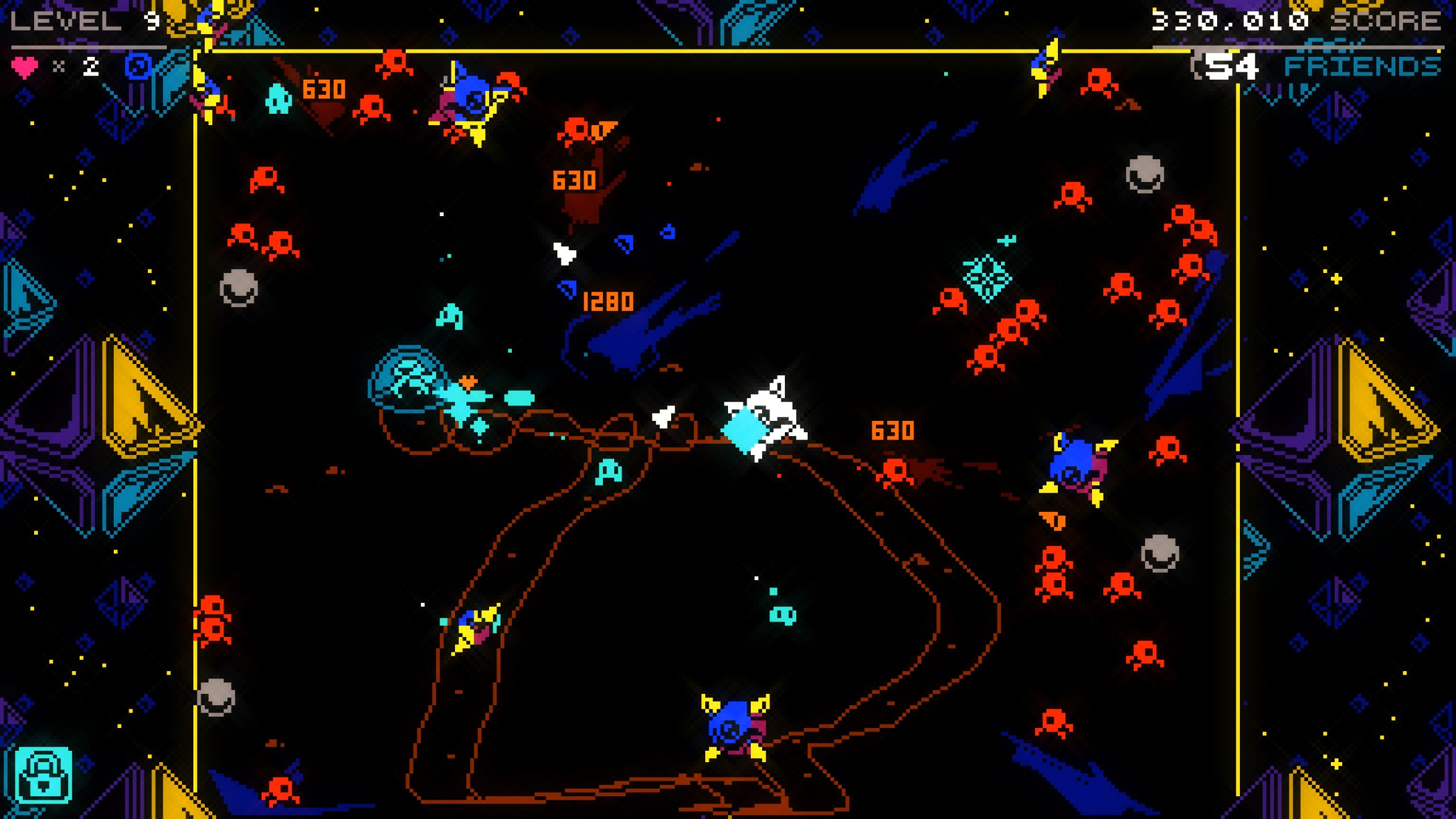
Satryn does support keyboard and mouse as well as controllers and because the game is designed as a twin-stick shooter, I decided to play with a modern controller. You move your character with one stick and shoot with the other. It’s pretty simple and easy to pick up and play and unlike Robotron: 2084, it’s not designed to eat your money. That’s doesn’t mean Satryn is easy because things do get more challenging but based on my experience, it’s a bit more forgiving. Robotron usually destroys me within the first ten levels. Game over. In Satryn, I was consistently able to get past level ten. Obviously, practice is key for both games. Despite the obvious Robotron influences here, there are some differences that make Satryn unique.
So here’s how it works. You’re placed in a level which is like an arena you can move around freely. You shoot enemies to score points and each friend you save will increase the score multiplier. Enemies can kill your friends so, ideally, you want to save them before that happens which can be hard to do at times because enemies are usually everywhere. Saving sixty friends awards you an extra life. If you get hit, you lose a life and the score multiplier will be reduced by thirty five percent which can only occur once per level. Once all the enemies in a level are defeated, you move onto the next level. So you go from level to level until you lose all your lives. Lose them all and you start over from level one. The ultimate goal is to achieve the highest possible score.
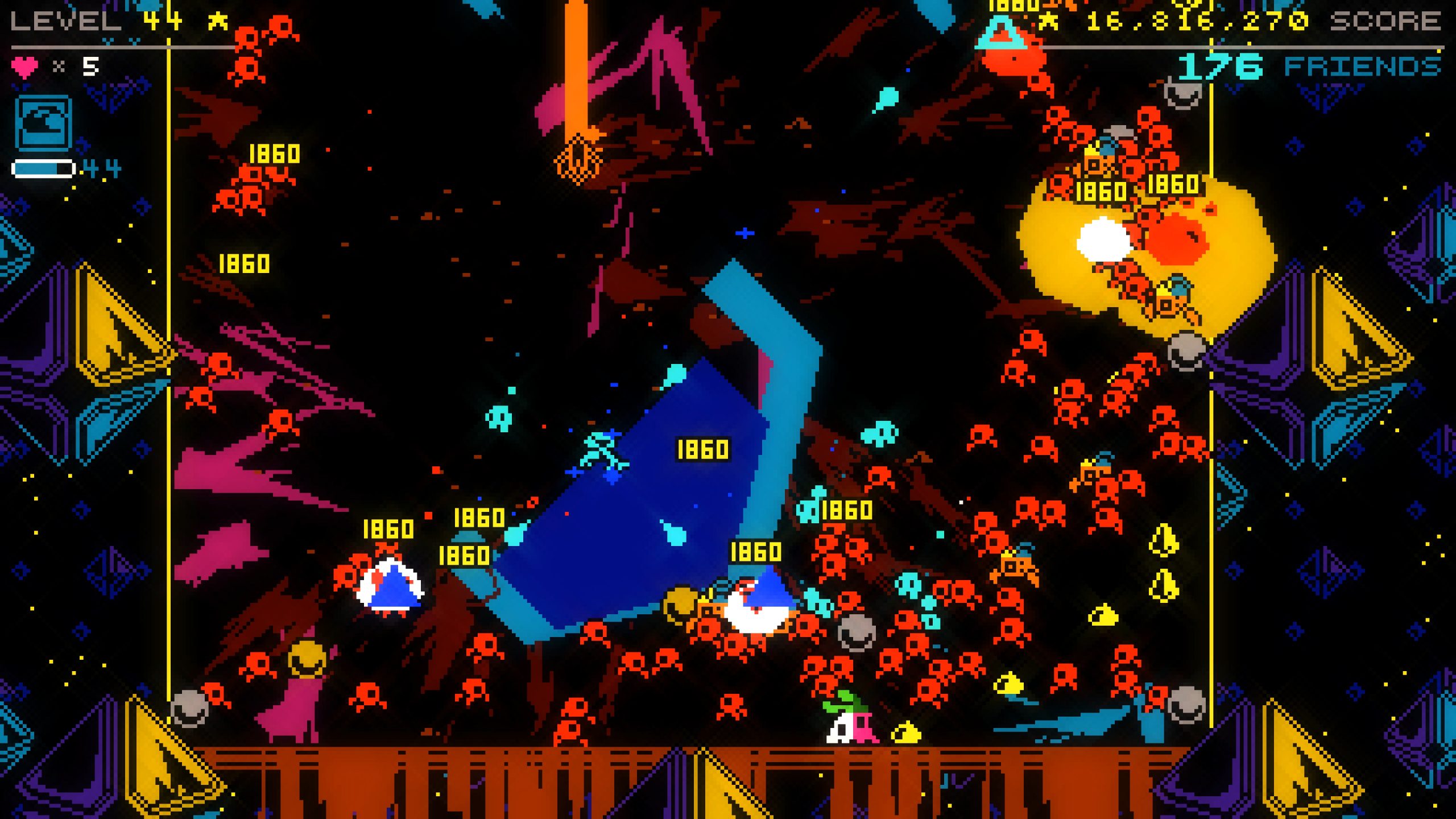
Satryn is the kind of game that’s easy to jump into but you have to be able to tolerate repetition. There’s a little over ten enemies total so you’ll be shooting the same ones repeatedly. Some fire projectiles, others rush you, you typically start levels outnumbered and surrounded, and will also have to be mindful of hazards as well like mines and black holes among other things. You always need to be on the move. The toughest foe is easily the Keeper which I would consider a boss-type – the only one in the game – and sometimes you’ll have to face multiple in a single level. Your character fires what I call a standard shot and, luckily, you never have to worry about ammo for it. To help you out are power-ups that spawn in the levels. Most are more powerful weapons with limited ammo and once you run out, that’s it. Back to your standard shot. One power-up you want to keep an eye out for is the shield because it can absorb damage. In other words, it allows you to take a hit without dying and you can stack up to three.
One thing that isn’t covered in the manual or on the game’s itch.io or Steam pages is the randomization. I know there is some RNG going on in Satryn because the developer responded to a comment on the game’s itch.io page stating “shields are completely rng-dependent” and that “it’s probably the weakest aspect of the game”, whatever that means. But I’m also guessing the levels are randomized, procedurally generated, or at least it seems that way. Not the level layout which is always the same but the enemy combinations. It’s always different. You can test it out by simply repeating level one multiple times. You’ll see it doesn’t always throw the same enemies at you and I think this is somewhat significant for the type of game Satryn is. While reaching better scores and higher levels will require practice, memorization doesn’t really fit into it. Personally, I like that because it means every run will be different.
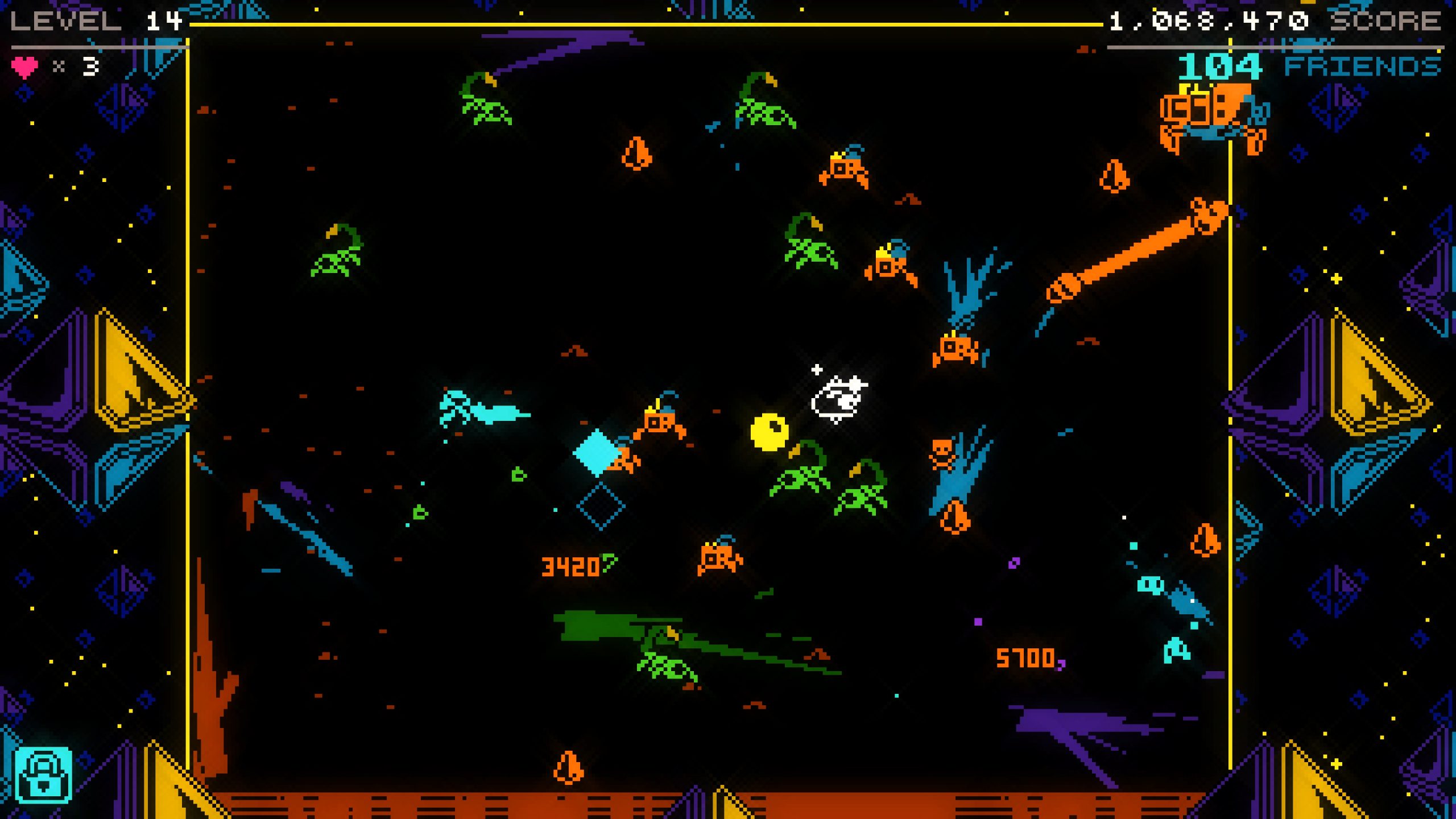
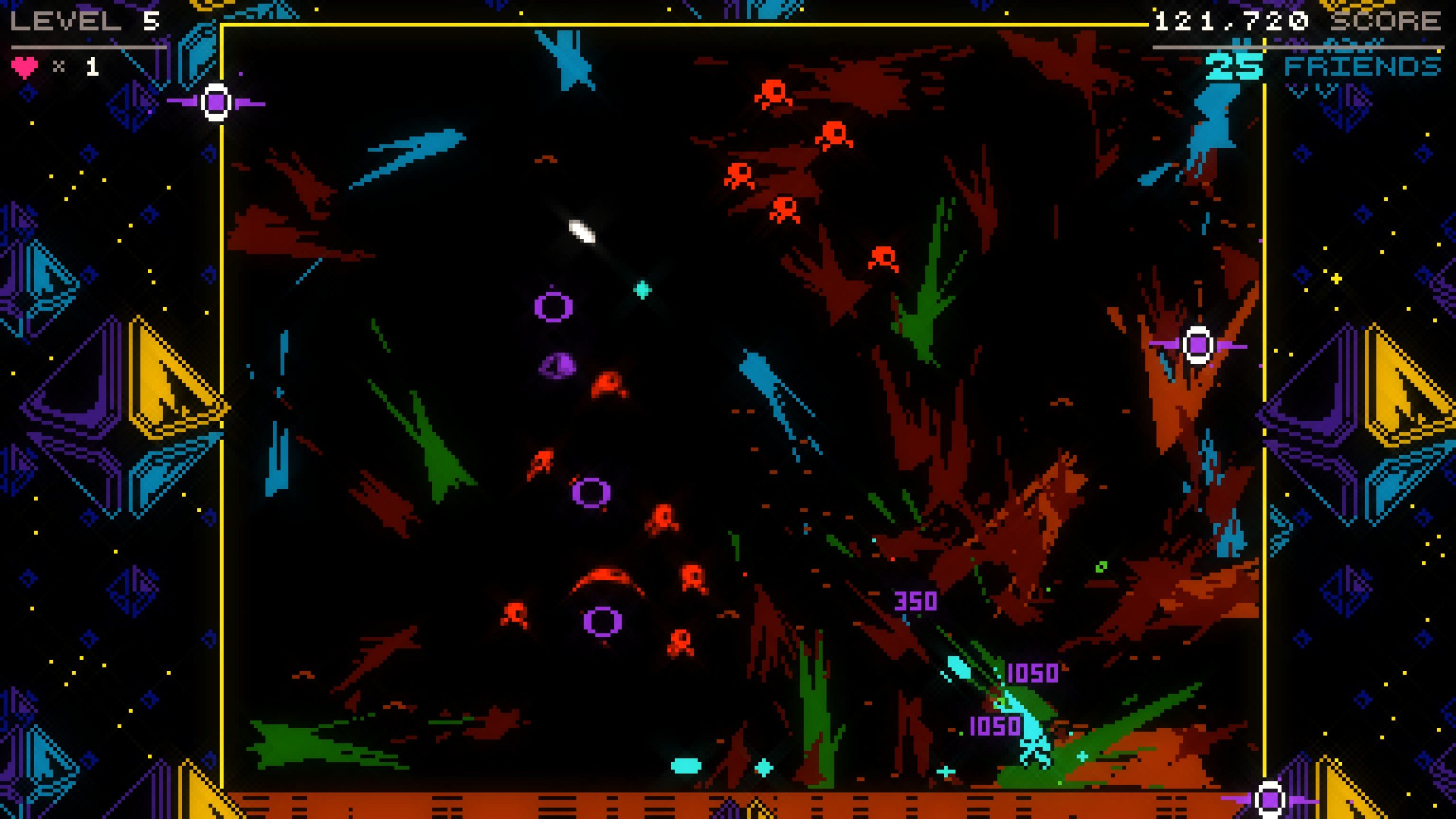
One might say Satryn aims for a retro look and I think it’s pixel sprite presentation is charming. Everything I needed to see was always clearly visible and one particular detail I enjoy is the splatter left behind by defeated enemies. I think Satryn utilizes its limited color palette well. Enemies and projectiles are different colors which makes them easy to identify and all the splatter from all the carnage can result in backgrounds looking like abstract paintings. I also enjoyed the sound work, specifically the sounds of shots and explosions. That, combined with the splatters results in action that feels very satisfying to me. On the technical side, I encountered no issues.
I had a really great time with Satryn Deluxe. It’s easy to pick up and play, can be enjoyed in short bursts or long sessions, and it scratches that twin-stick shooter itch for me. When I search for twin-stick shooters, games like Robotron and Smash TV, Satryn is exactly the type of game I’m looking for. Satryn, Xeno Crisis, Nex Machina, Geometry Wars – games like these. Satryn is fast-paced, chaotic, action-packed, and I had a lot of fun with it. It may wear its Robotron influence on its sleeve but I think it’s a more welcoming experience. But keep in mind, there’s not much to see and do. Satryn is a score attack game through and through. The ultimate goal is to achieve the highest possible score and that’s really all there is to it.
I absolutely recommend Satryn Deluxe. You can play the standard version for free or get the Deluxe version on Steam and Switch and I think it’s worth the seven dollar asking price. It doesn’t offer a lot of content but it does provide an experience that can keep you occupied for quite some time. It all depends on how much you enjoy chasing high scores. Satryn is simple to understand and get into and one that will require a bit of practice and most likely, many repeated attempts to reach the top of the leaderboards. So if you’re looking for a fast-paced and action-packed arcade-style twin-stick shooter, definitely check out Satryn Deluxe.